
Overview: Learn how robotic anti-reflux surgery treats GERD long term, who qualifies, benefits, risks, and recovery expectations explained clearly!
Living with chronic GERD is rarely just about heartburn. It can mean disrupted sleep, constant throat irritation, chest discomfort, food avoidance, and long-term dependence on medication. While acid-suppressing drugs help many patients, some continue to experience breakthrough symptoms or structural problems like hiatal hernias.
For those individuals, robotic anti-reflux surgery may offer a structural solution rather than ongoing symptom control. But understanding when surgery makes sense, and what long-term relief truly means requires a closer look.
When Does GERD Become a Structural Problem Instead of a Chemical One?
GERD is often treated as an acid issue, but in many cases, it is a mechanical failure. The lower esophageal sphincter (LES) is meant to act as a valve between the stomach and esophagus. When it weakens or when a hiatal hernia alters anatomy, acid control medications reduce acidity but do not fix the underlying defect.
Surgery addresses this structural weakness by reinforcing the barrier that prevents reflux in the first place.
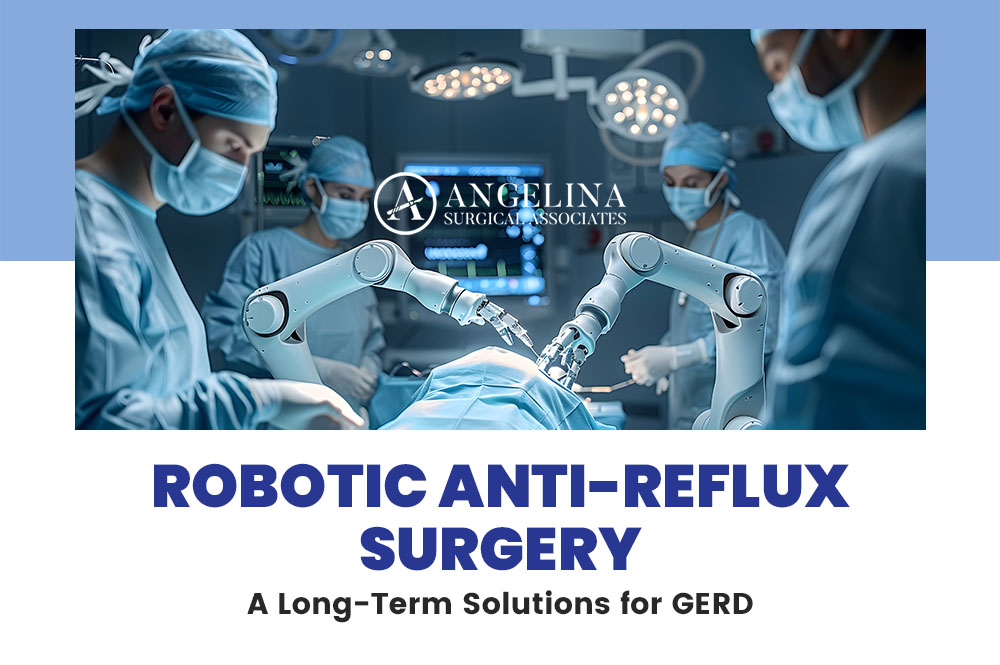
How Does Robotic Technology Improve Anti-Reflux Reconstruction?
Anti-reflux surgery requires careful dissection around the diaphragm and esophagus — areas dense with critical structures. Precision in this region directly affects swallowing function and long-term symptom control.
The robotic platform provides:
-
Three-dimensional magnified visualization
-
Enhanced instrument articulation for fine suturing
-
Stable control during reconstruction of the hiatal opening
This level of refinement can be particularly helpful in patients with large hiatal hernias or prior abdominal surgery.
Does Surgery Actually Reduce Long-Term Dependence on GERD Medication?
For many appropriately selected patients, yes.
Long-term follow-up studies of fundoplication procedures show sustained symptom control and reduced reliance on proton pump inhibitors in a majority of patients. The American College of Gastroenterology recognizes anti-reflux surgery as an established option for patients with objectively confirmed GERD who do not respond adequately to medical therapy.
Surgery does not eliminate acid production; it restores the barrier that prevents reflux from occurring.
What Changes After Surgery and What Doesn’t?
Robotic fundoplication reshapes the junction between the stomach and esophagus. After surgery:
-
Acid exposure to the esophagus typically decreases
-
Regurgitation often improves significantly
-
Chronic cough related to reflux may lessen
However, patients may temporarily experience bloating or mild swallowing difficulty during healing. These effects usually improve as swelling resolves and the body adapts.
Lifestyle awareness remains important, but many patients regain comfort and dietary flexibility.
Is Robotic Anti-Reflux Surgery Always the Right Choice?
Surgery is not automatically the next step for every GERD patient. Ideal candidates typically have:
-
Documented acid reflux on testing
-
Persistent symptoms despite optimized medication
-
Anatomical contributors such as hiatal hernia
Patients with functional heartburn or symptoms unrelated to reflux may not benefit from surgery. Thorough diagnostic evaluation is essential before proceeding.
Frequently Asked Questions (FAQs)
How long does relief from anti-reflux surgery last?
Many patients experience durable relief for years, though outcomes depend on proper diagnosis and surgical technique.
Can GERD return after surgery?
Recurrence is possible but uncommon when anatomy is properly repaired and patients are well selected.
Is robotic fundoplication safer than traditional laparoscopic surgery?
Both are safe. Robotic technology may offer enhanced precision in complex cases.
Final Words
Robotic anti-reflux surgery offers a long-term structural correction for GERD when medication alone is not enough. It shifts treatment from managing acidity to restoring anatomy.
The decision is not about avoiding medication at all costs but about choosing the approach that aligns with your diagnosis, symptom severity, and long-term goals.
When GERD begins to affect daily living despite proper medical therapy, it may be time to explore whether surgical repair provides the lasting relief you’ve been looking for.
Still struggling with reflux despite treatment? Learn more or schedule a consultation with Angelina Surgical