
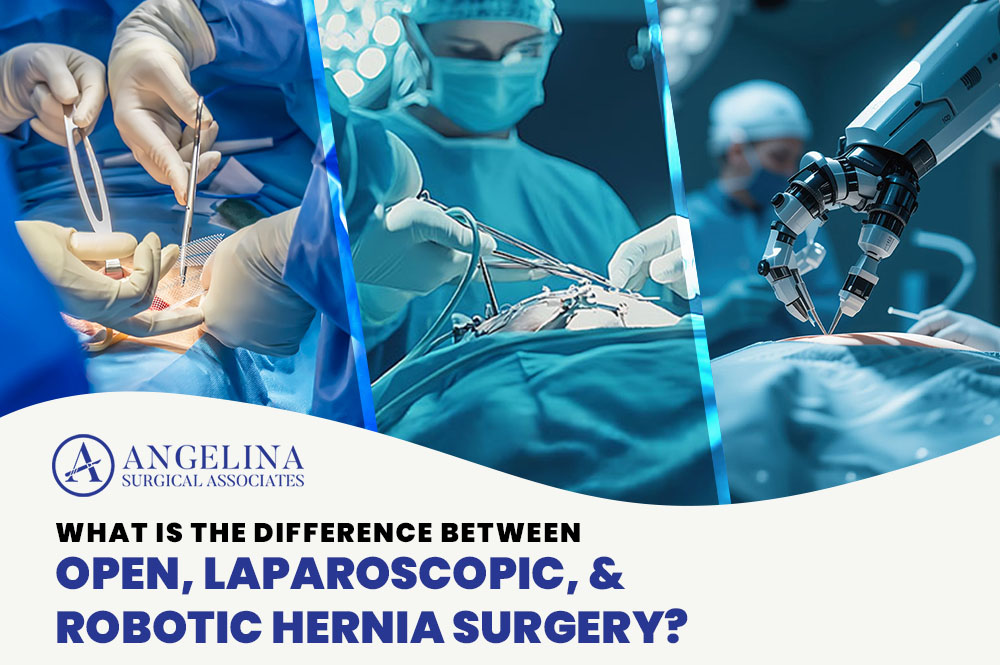
Overview: What’s the difference between open, laparoscopic, and robotic hernia surgery? Compare recovery, precision, risks, and benefits!
When someone is told they need hernia surgery, the next question is often, “Which type?” Open, laparoscopic, and robotic hernia repairs are all established techniques. Each has its place in modern surgery. The differences are not about which one is “best” in general — but which one is best for a particular patient, hernia type, and clinical situation.
Understanding how each method works, and what that means for recovery and outcomes — can make the decision feel far less overwhelming.
How Does Open Hernia Surgery Work?
Open hernia repair is the traditional and time-tested method. It involves making an incision directly over the hernia site. The surgeon gently returns the protruding tissue to its proper position and reinforces the weakened muscle wall, often using surgical mesh.
When Is Open Repair Often Chosen?
Open surgery may be recommended for:
-
Large or complex ventral hernias
-
Emergency cases, such as strangulated hernias
-
Patients with medical conditions limiting minimally invasive surgery
Because the incision is larger, there may be more early postoperative discomfort. However, open repair remains highly effective and is still the safest approach in certain scenarios.
What Makes Laparoscopic Hernia Surgery Different?
Laparoscopic hernia repair is minimally invasive. Instead of one larger incision, several small incisions are made. A camera and specialized instruments are inserted through these ports, allowing the surgeon to repair the hernia from inside the abdominal cavity.
This approach typically uses mesh to reinforce the weakened area.
How Does This Affect Recovery?
Smaller incisions often mean less surface tissue disruption. Many patients experience:
-
Reduced early pain
-
Smaller scars
-
Faster return to light activities
Laparoscopic repair is frequently used for bilateral inguinal hernias or recurrent hernias after a prior open repair.
Also Read >> Laparoscopic Hernia Surgery Vs. Open Hernia Surgery: Which is the Best?
What Is Robotic Hernia Surgery?
Robotic hernia surgery builds upon laparoscopic techniques. The procedure is still minimally invasive, but the surgeon operates from a console that controls robotic instruments.
The system provides high-definition, three-dimensional visualization and instruments that articulate with greater flexibility than standard laparoscopic tools.
Why Does Instrument Movement Matter?
Robotic instruments can mimic wrist-like movements inside the body. This enhanced dexterity may allow for more precise suturing and careful tissue handling, particularly in complex or deep anatomical areas.
Robotic repair is often considered for ventral, incisional, and certain inguinal hernias where delicate dissection or reconstruction is required.
How Do Outcomes and Recurrence Rates Compare?
When performed by experienced surgeons, all three techniques offer strong long-term outcomes. Recurrence rates depend more on hernia size, mesh placement, patient health, and surgical expertise than on the chosen method alone.
Minimally invasive approaches — laparoscopic and robotic, often offer shorter hospital stays and quicker early mobility. Open repair remains equally effective in appropriately selected cases.
Is One Approach Safer Than the Others?
Safety is determined by:
-
The type and size of the hernia
-
Whether the surgery is elective or emergent
-
The patient’s overall health
-
Surgeon training and experience
Technology enhances capability, but judgment and individualized planning remain central to good outcomes.
Frequently Asked Questions (FAQs)
Does robotic hernia surgery mean better results?
Not automatically. It offers enhanced precision, but outcomes depend on patient selection and surgeon expertise.
Is recovery always faster with minimally invasive surgery?
Many patients recover more quickly, but recovery varies based on hernia size and overall health.
Can all hernias be repaired laparoscopically or robotically?
No. Some large or emergency hernias are safest with open repair.
Final Words
Open, laparoscopic, and robotic hernia surgery are not competing techniques — they are complementary tools. The right choice depends on anatomy, complexity, and patient-specific factors.
A thoughtful surgical consultation focuses not on what sounds advanced, but on what offers the safest repair and most reliable long-term result for you.
Considering hernia repair and unsure which approach is right for you? Learn more or schedule a consultation with Angelina Surgical.