
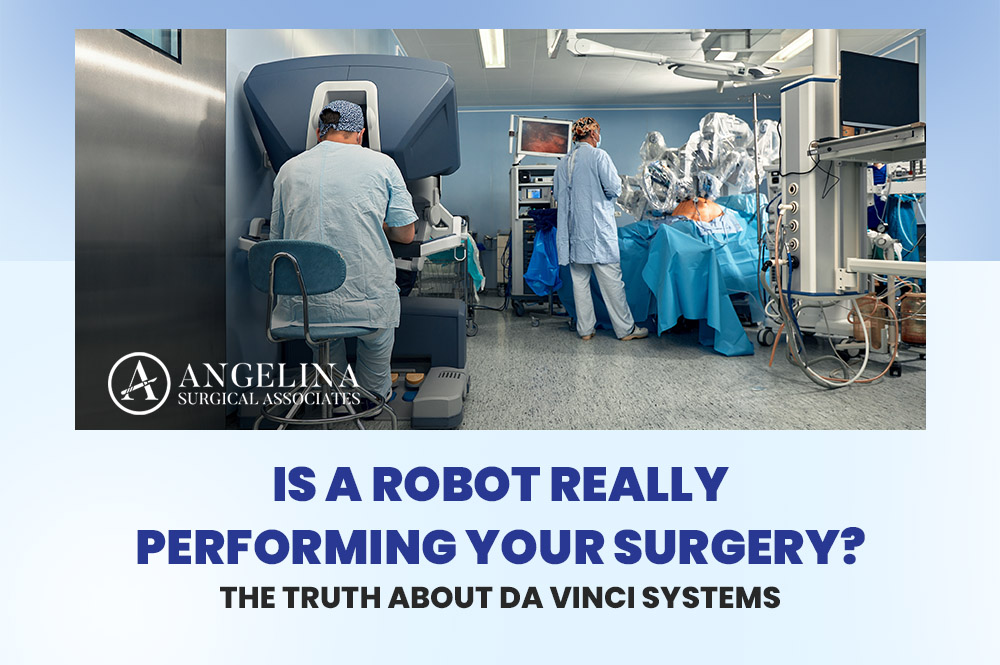
Overview: Is a robot really performing your surgery? Learn how da Vinci systems work, who controls them, and what robotic surgery means for patients!
Hearing the term robotic surgery can raise an understandable question: Is a robot actually doing the operation? For many patients, the idea can feel unfamiliar — and sometimes unsettling.
The reality is far more reassuring. Robotic-assisted surgery is not about replacing the surgeon. It’s about enhancing the surgeon’s ability to perform complex procedures with greater control, visibility, and precision.
Understanding how the da Vinci® system works helps separate perception from reality.
Who Is Actually in Control During Robotic Surgery?
At every moment of the procedure, the surgeon is fully in control.
The da Vinci® system does not make decisions, move independently, or perform any action on its own. Every movement of the robotic instruments is directed in real time by the surgeon, who operates from a nearby console.
If the surgeon stops, the system stops. There is no automation, no pre-programmed action, and no artificial decision-making involved.
Why Does It Look Like a Robot Is Doing the Surgery?
In the operating room, the robotic system is positioned over the patient with multiple mechanical arms. This visual can give the impression that the machine is operating independently.
In reality, those arms are simply holding and moving surgical instruments under the surgeon’s direct control. The console allows the surgeon to guide those movements with enhanced precision, much like using highly advanced tools rather than traditional handheld instruments.
What Does the da Vinci® System Actually Do?
The system translates the surgeon’s hand movements into smaller, more refined actions inside the body.
Motion Scaling and Stability
Large hand movements can be scaled down into tiny, controlled motions. Natural hand tremor is filtered out, allowing for steadier surgical work.
Enhanced Visualization
The surgeon views the surgical area in high-definition, three-dimensional detail. This improved depth perception helps identify structures more clearly than traditional methods.
Greater Instrument Flexibility
Robotic instruments can move with a wider range of motion than standard laparoscopic tools, allowing for more precise suturing and dissection.
Does Robotic Surgery Change the Role of the Surgeon?
No, it expands it.
The surgeon remains responsible for every step of the procedure, including planning, execution, and decision-making. The robotic system serves as an extension of the surgeon’s hands, offering improved control in complex or confined areas.
Experience and judgment remain the most important factors in achieving a successful outcome.
Why Do Surgeons Use Robotic Systems at All?
Robotic-assisted surgery is used because it can enhance surgical performance in certain cases.
Potential advantages include:
-
More precise movements
-
Better visualization of anatomy
-
Smaller incisions
-
Reduced tissue disruption
These benefits may translate into less postoperative pain, shorter hospital stays, and quicker recovery for many patients — depending on the procedure.
Is Robotic Surgery Safe?
Yes. Robotic-assisted surgery is widely used across multiple specialties and has been studied extensively.
According to the U.S. Food and Drug Administration (FDA), robotic surgical systems are cleared for use in a variety of procedures and are considered safe when operated by trained surgeons.
As with any surgery, safety depends on proper patient selection, surgical planning, and the experience of the care team.
Also Read >> Is da Vinci Robotic Surgery Really More Precise?
Frequently Asked Questions (FAQs)
Does the robot make decisions during surgery?
No. The surgeon controls every movement. The system does not act independently.
Is robotic surgery better than traditional surgery?
It can offer advantages in certain cases, but the best approach depends on the procedure and the patient.
Can robotic surgery fail or malfunction?
Modern systems have multiple safety features. In rare cases, surgeons can switch to another method if needed.
Final Words
A robot is not performing your surgery — your surgeon is.
The da Vinci® system is a tool designed to enhance precision, visibility, and control. It does not replace human expertise, judgment, or care. Instead, it supports the surgeon in delivering safe and effective treatment. Understanding this distinction can help patients feel more confident and informed when considering robotic-assisted procedures.
Have questions about robotic surgery or your treatment options?
Learn more or schedule a consultation with Angelina Surgical.